Designing a Deterministic AI Cinematic Workflow Under Hard Engine Constraints
Project Overview
This project focused on designing and engineering a multi-scene cinematic sequence using a generative AI engine under strict technical constraints.

Rather than approaching this as a creative prompt exercise, the project was structured as a systems design challenge: how to create a reliable, repeatable, multi-state interaction workflow within a probabilistic AI environment.
The objective was to:
• Ensure deterministic multi-subject rendering
• Preserve narrative continuity across scene states
• Eliminate ambiguity that caused generation failure
• Optimize for platform constraints
• Reduce production risk (credit expenditure per iteration)
This case study demonstrates constraint modeling, interaction architecture, system debugging, and outcome stabilization under platform limitations.
The Problem
The core problem was not artistic — it was structural:
Generative video engines introduce unpredictable behaviors, including:
• Single-subject dominance bias
• Misinterpretation of vague action verbs
• Camera continuity collapse
• Over-stylization of effects
• UI character truncation
• Late-token deprioritization
The challenge was not visual Fidelity – it was reliability.

The engine UI had undocumented character limitations.
Credit cost per generation required high success probability per attempt.
Scene continuity had to be preserved across multiple transitions (macro → wide → collision → stabilization).
The Challenge: build a scene that renders correctly on the first generation attempt.
How do you design an interaction system inside a 
probabilistic engine so that complex multi-subject behavior renders consistently – on the first attempt?
Project Constraints
Hard system constraints included:
• 1,800 characters ceiling (including spaces and line breaks).
• Explicit camera behavior required.
• No ambiguous mechanical language.
• No interpretive phrasing.
• Fire affects constrained by rule system.
• No stylization, bleed into realism.
Constraint discovery was empirical. Initial assumptions (2,640 character limit) failed under UI behavior. Through iterative testing, the operational safe ceiling was reduced to 1,800 characters. This reflects platform literacy and adaptive constraint modeling.

These were not aesthetic preferences — they were structural safeguards.
Interaction Design: A/B Narrative Entry Point
The experience began with a binary A/B decision structure.
This was an intentional engagement strategy to convert passive viewers into active participants. The binary decision architecture increased all time and created psychological ownership of the outcome. The chosen path was preserved in a canonical cinematic build. 
Rather than a branching gimmick, It served as a behavioral trigger mechanism – anchoring a consequence to use your input and reinforcing engagement accountability.
Interaction Design: A/B Narrative Entry Point
Interactive Opening
The project began with an A/B branching mechanism. This was an intentional engagement strategy to convert passive viewers into active participants. It served as a behavioral trigger mechanism – anchoring a consequence to user input and reinforcing engagement accountability.
This accomplished:
• Immediate engagement
• User ownership of narrative escalation
• Psychological investment in the outcome
• The viewer’s decision shaping the canonical cinematic path.
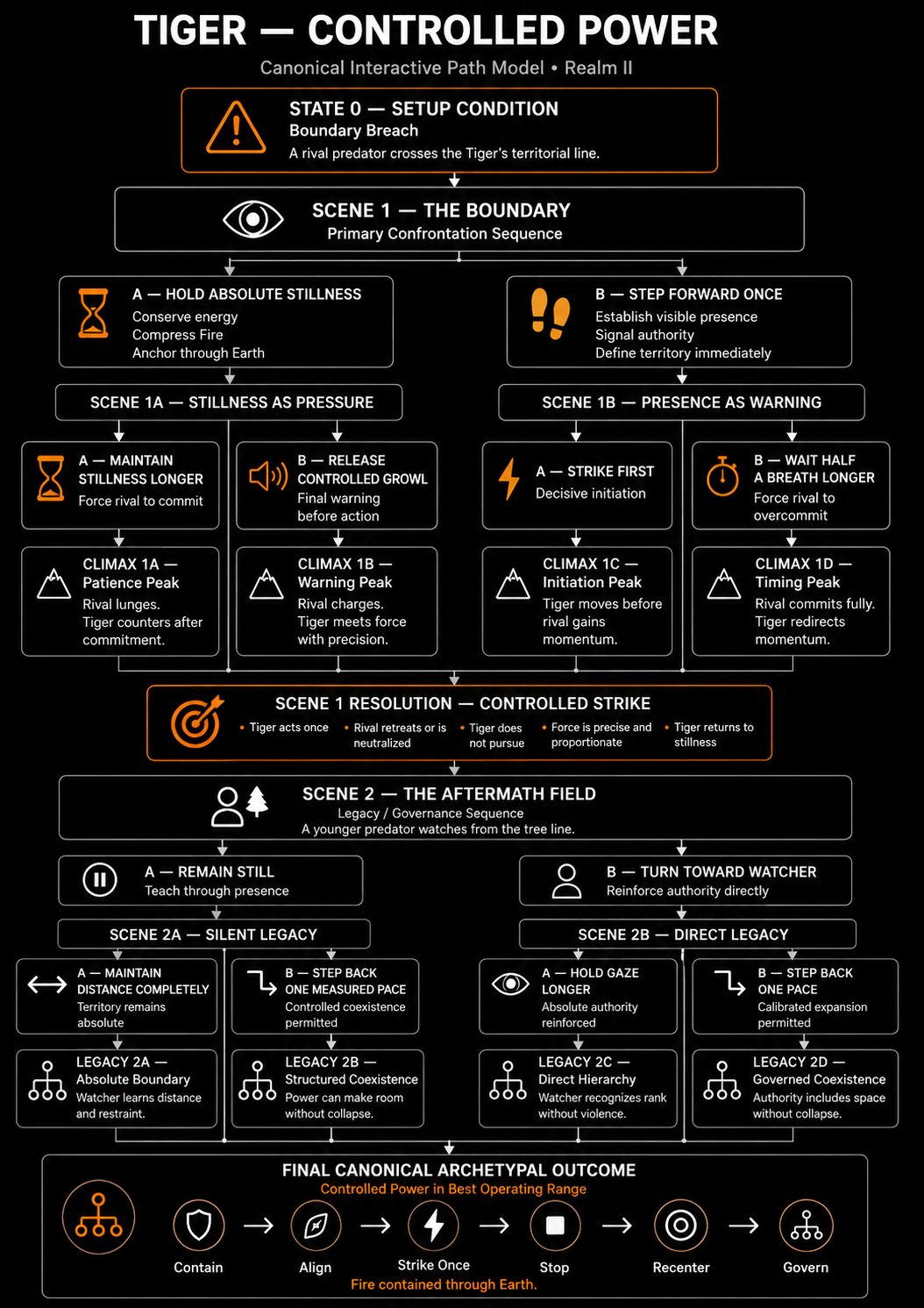
This created narrative consequence alignment:
• The eventual strike was not random — it was selected.

Experience Transition
The project successfully transitioned from:
Interactive branching prototype → to Cinematic production sequence
While preserving the selected decision path.
This is experience convergence design.
TIGER — CONTROLLED POWER
Canonical Interactive Path Model (Realm II)
                              ┌───────────────────────────────┐
                              │ SCENE 1 — Boundary Tested     │
                              │ Rival crosses territorial line │
                              └───────────────┬───────────────┘
                                              │
                           ┌──────────────────┴──────────────────┐
                           │                                     │
                   A — Hold Stillness                    B — Step Forward
                 (Conserve / Compress)               (Visible Presence)
                           │                                     │
            ┌──────────────┴──────────────┐        ┌─────────────┴──────────────┐
            │                             │        │                            │
   A — Maintain Stillness         B — Controlled     A — Strike First     B — Force Commitment
   (Force Rival Commitment)           Growl           (Initiate Impact)     (Wait Half-Breath)
            │                             │        │                            │
            │                             │        │                            │
   ┌────────┴────────┐           ┌────────┴───────┐│            ┌──────────────┴──────────────┐
   │                 │           │                ││            │                             │
Rival Lunges   Tiger Counters  Rival Charges  Tiger Meets   Immediate Dominance     Rival Overextends
First          With Precision  Through Warning With Timing   Through Initiation     Momentum Redirected
   │                 │           │                ││            │                             │
   └────────────┬────┘           └────────┬───────┘└────────────┴──────────────┬──────────────┘
                │                         │                                      │
                └─────────────── CLIMAX RESOLUTION ──────────────────────────────┘
                                (Single Controlled Strike)
                                          │
                                          ▼
                           ┌───────────────────────────────┐
                           │ SCENE 2 — Aftermath Field     │
                           │ Younger Predator Observes     │
                           └───────────────┬───────────────┘
                                           │
                              ┌────────────┴────────────┐
                              │                         │
                 A — Remain Fully Still        B — Step Back One Pace
                 (Absolute Territory)          (Calibrated Expansion)
                              │                         │
               ┌──────────────┴─────────────┐           │
               │                            │           │
   Territory Remains Rigid          Watcher Retreats    │
   Hierarchy Reinforced             Lesson = Fear       │
   Authority = Distance                                │
                                                         │
                                              ┌──────────┴──────────┐
                                              │                     │
                                   Watcher Holds Boundary     Structured Coexistence
                                   Learns Through Distance     Authority Without Force
                                              │                     │
                                              └──────────┬──────────┘
                                                         │
                                                         ▼
                                        FINAL ARCHETYPAL EXPRESSION
                                        ───────────────────────────
                              Controlled Power in Best Operating Range
                              • Fire contained, not scattered
                              • Earth stabilizes escalation
                              • Action is singular and proportionate
                              • Authority persists without excess
                              • Boundary adapts without collapsing
Engine Behavior Diagnosis
The project followed a structured refinement model:
1. Hypothesis: collision language sufficient
2. Test: generation failure
3. Diagnose: subject dominance bias
4. Refine: explicit overlap + framing enforcement
5. Test: improved stability
• Detect UI truncation
• Compress under safe ceiling
• Validate deterministic outcome
This reflects a UX research loop applied to machine cognition:
Observe → Diagnose → Refine → Validate.
Failure states were treated as system signals, not creative setbacks.
A. Single-Subject Dominance Bias
Scenes centered heavily on the primary tiger caused the engine to deprioritize the rival during collision.
Mitigation:
• Explicit dual-subject framing
• Frame containment instruction
• Reassertion of both subjects pre- and mid-impact
Action Ambiguity
Words like “lunges,” “collides,” or “drives toward” allowed the engine to render near-contact rather than impact.
Mitigation:
• Explicit limb mechanics.
• Explicit contact point.
• Explicit fur compression.
• Explicit downward displacement.
• Explicit rival collapse.
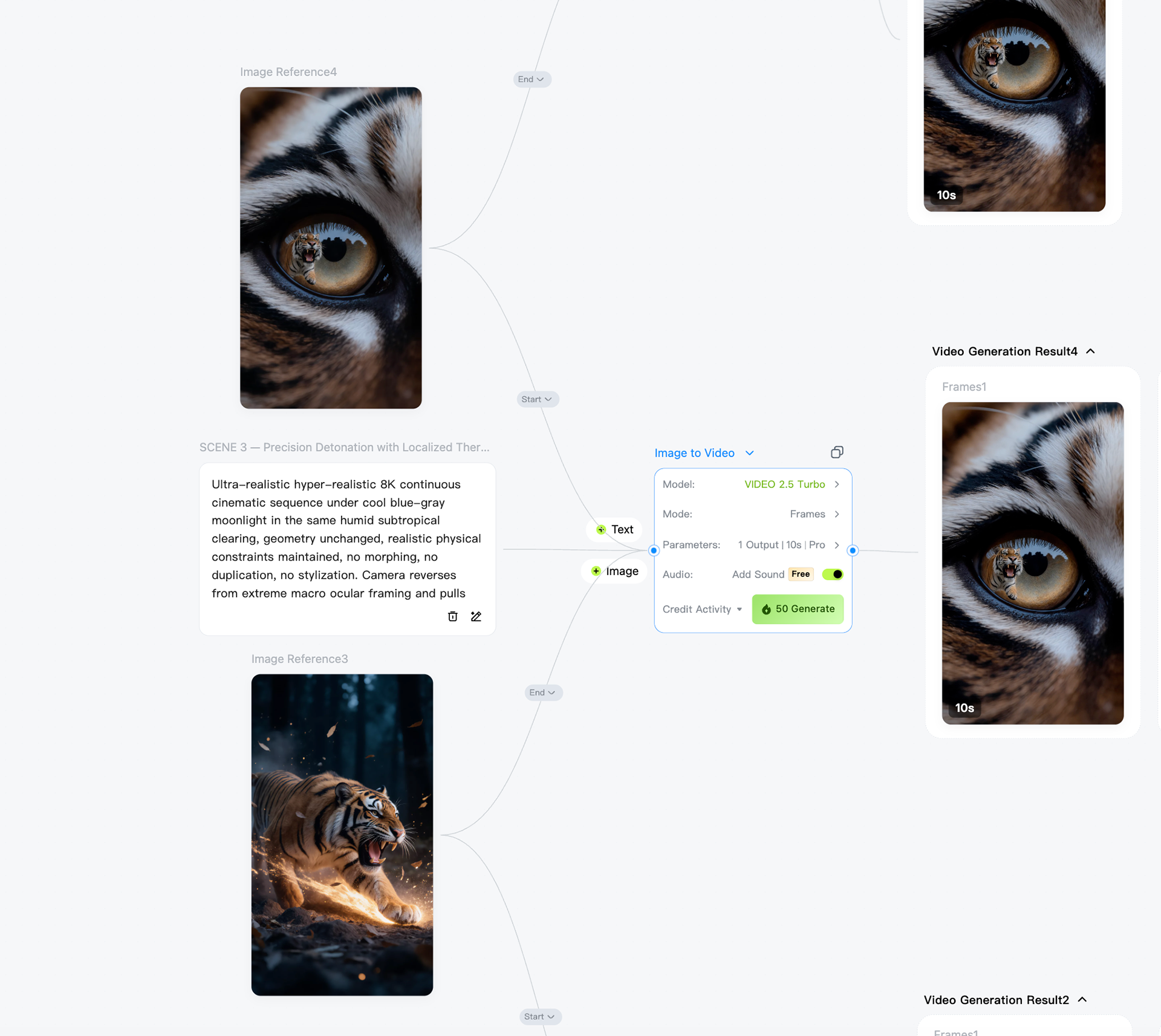
Camera Continuity Collapse
Without an explicit camera reversal from macro, the engine remained tight on the primary tiger.
Mitigation:
• Required macro exit clause.
• Defined camera pull-back.
• Defined lateral tracking during collision.
Camera reverses from extreme macro ocular framing and pulls back to a wide grounded composition containing both adult Bengal tigers separated by approximately two body lengths and facing each other directly. Camera remains at chest height and begins controlled lateral tracking aligned with the strike vector, maintaining both bodies fully in frame with no zoom and no shake. 
Thermal Overrender
Without constraints, thermal effects risked rendering as glowing fur or supernatural aura.
Mitigation:
• Fire strictly ground-bound.
• No body glow.
• No fur contact.
• Collapse within one breath.
Prompt Engineering Evolution
The prompt went through several transformations:
• Abstract impact language → Failed.
• Added physical collision → Still failed.
• Enforced body overlap → Improved.
• Added camera behavior → Stabilized.
• Removed ambiguous phrasing → Deterministic.
• Reduced to 1,800-character ceiling → Engine-safe.
• Explicit macro-to-wide transition → Spatial continuity preserved.
Each revision removed one interpretation variable.
This is systematic ambiguity elimination. These adjustments reflect designing for known failure vectors — a hallmark of systems thinking.

Narrative Integrity
Despite compression and constraint enforcement, the archetypal arc remained intact:
Presence
→ Compression → Confrontation → Singular decisive strike → Thermal imprint → Rival displacement → Stabilization → Younger witness → Shared territory
The core theme — Controlled Power — remained consistent.
Not frenzy.
Not chaos.
One strike.
Restored order.

Camera & Composition Control
Final camera logic included:
• Macro ocular compression (Scene 2)
• Explicit reversal from macro (Scene 3)
• Wide grounded framing
• Controlled lateral tracking aligned with strike vector
• No zoom during collision
• No artificial shake
• Full-body containment throughout impact
This eliminated frame collapse risk.

Sound Design Integration
Native audio is not reliable enough to obtain the artifacts necessary for optimal impact of the narrative, as such the following were intentionally layered in:
• Ambient insects narrowing during tension
• Dual exhale at impact
• Soil fracture crack
• Granular displacement
• Thermal collapse silence
• Ambient restoration
Sound was treated as structural, not decorative.

Sound Design as Structural State Indicator
Native audio is not reliable enough to obtain the artifacts necessary for optimal impact of the narrative, as such the following were intentionally layered in:
• Ambient insects narrowing during tension
• Dual exhale at impact
• Soil fracture crack
• Granular displacement
• Thermal collapse silence
• Ambient restoration
Sound was treated as structural, not decorative.

Additionally, a custom AI soundtrack was created to represent the narrative in tandem to compliment the integrated sound design built into the cinematic design. Using Suno, this was based off of the narrative, and genres were selected to emphasize the storytelling experience, as a full track was completed with customized lyrics to a specific section out for this final solution. 
What Was Successfully Built
This project achieved:
Deterministic dual-subject collision rendering
Explicit camera control
Explicit biomechanical sequencing
Explicit contact enforcement
Thermal manifestation discipline
Engine constraint compliance
Multi-scene continuity preservation
Narrative archetype fidelity
Credit-risk mitigation
This is full-stack generative cinematic engineering.
Back to Top